Technical rules for flat roofs
Flat Roof Guidebook – Part 6
This sixth and final part of our flat roof guidebook discusses the technical rules for flat roofs, choosing right type and number of fasteners as well as the issue of corrosion.
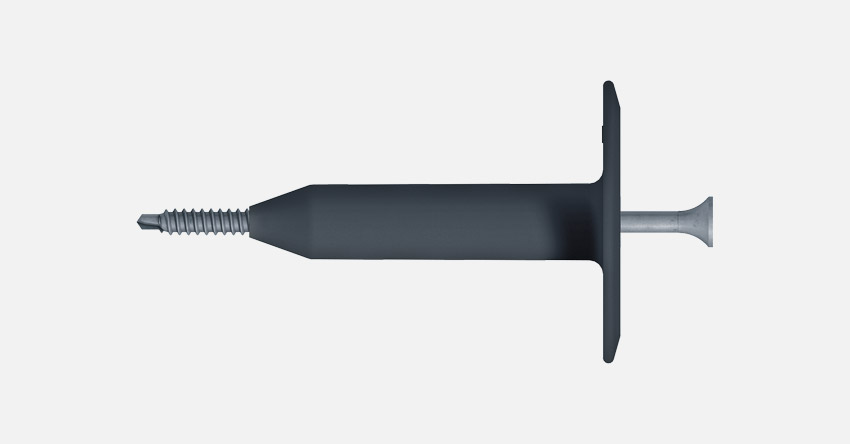
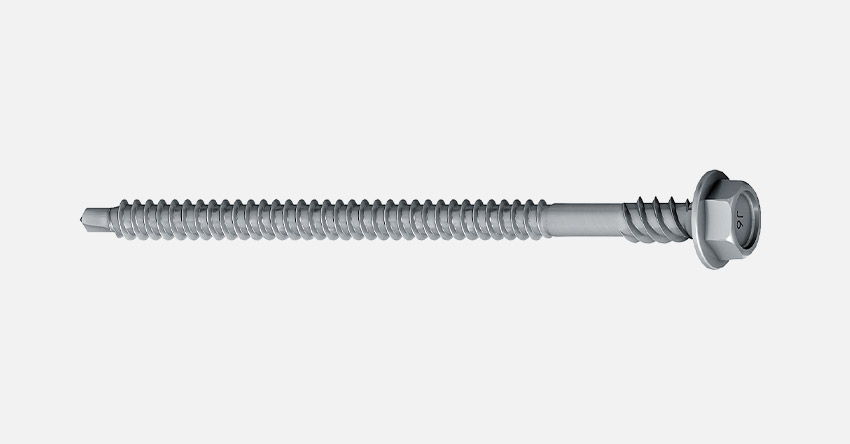
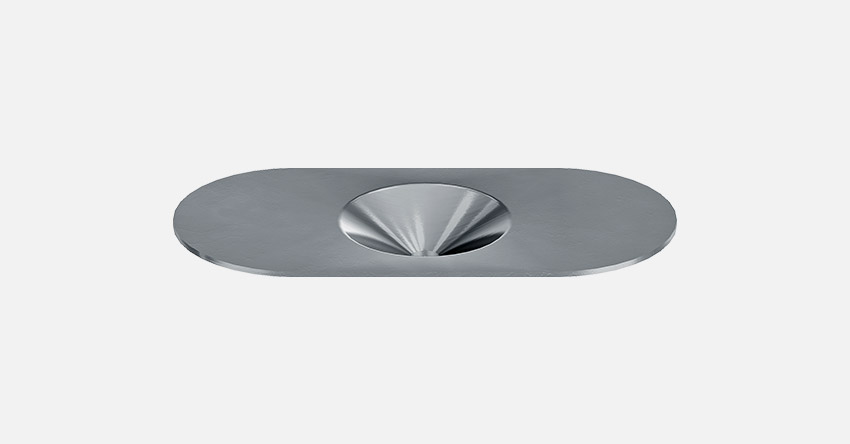
With regard to the number of fasteners to be used, the statements in the rules and regulations are to an extent not entirely uniform. The number of fasteners must be determined individually for the different areas of the roof surface, taking into account the wind loads in accordance with DIN EN 1991-1-4 and DIN EN 1991-1-4/NA.
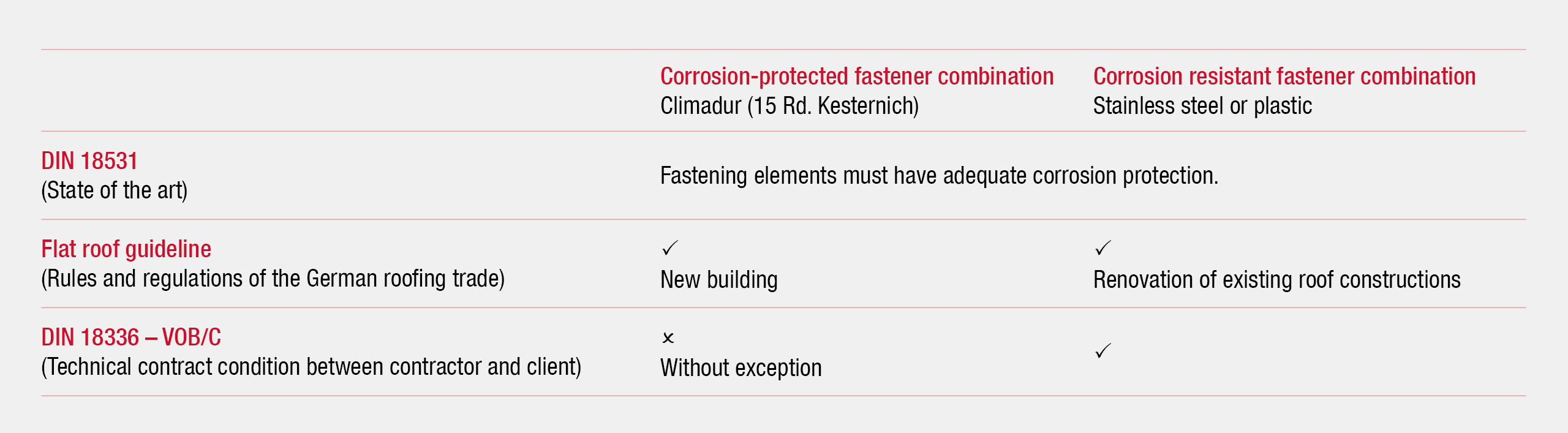
Also with regards to the type of fasteners, there is diverse information in the different regulations about the material of the fastening element. Until July 2025, DIN 18531 divided the roof structure into application classes K1 and K2, requiring a corrosion-resistant fastener for the higher-grade roof structure K2. In the current version, the application classes K1 and K2 no longer exist; now only adequate corrosion protection for the fasteners is generally required.
DIN 18336 belongs to VOB Part C. VOB Part C covers the general technical technical contract conditions for building services which have to be agreed by the client and contractor. All in all, VOB Part C includes numerous individual standards. In its latest version dated September 2023, point 3.2.1.8 of DIN 18336 states that only corrosion-resistant fasteners are to be used as mechanical fasteners.
According to the Flat Roof Guideline, corrosion-resistant fasteners (stainless steel) must be used in repairs when fasteners are screwed through existing roof assemblies. No statement is made on the general use of corrosion-resistant fasteners. We recommend the use of corrosion-resistant fasteners for repairs in bituminous or soaked roof structures.
Correctly understanding the regulations
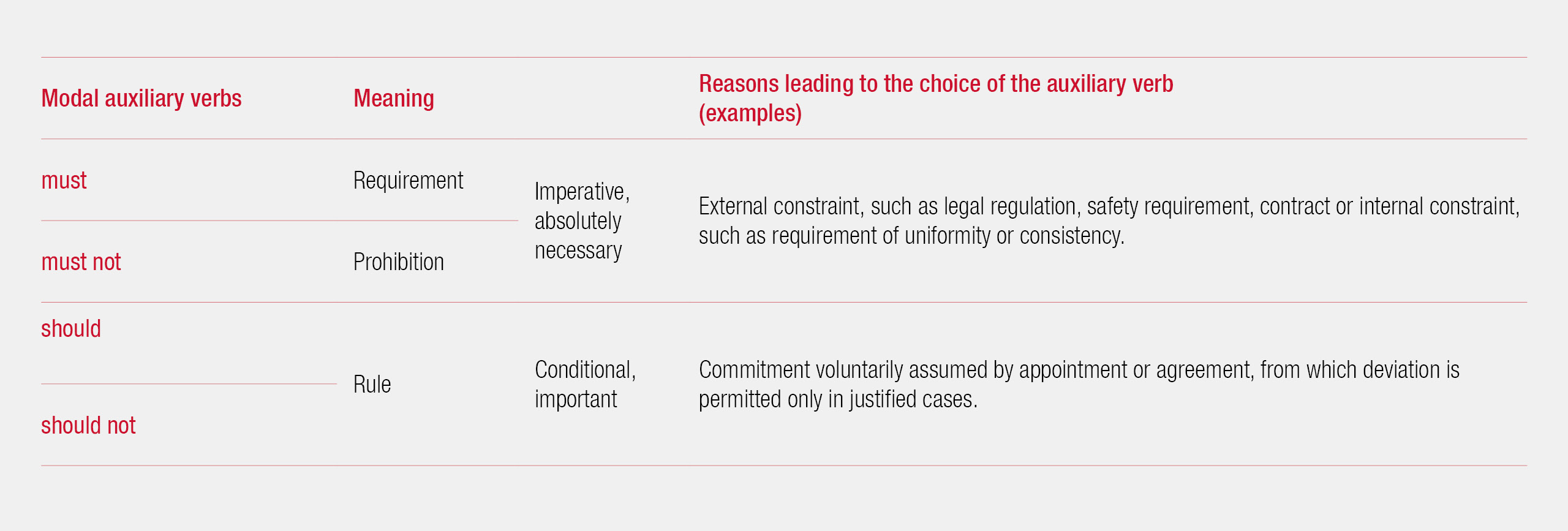
Often the modal verbs used are a cause for discussion. It should be noted that the verb “must” corresponds in meaning to a rule that is accepted as an obligation. It is therefore a regulation which the German Association for the Roofing Trade imposes on itself as the publisher of the "Specialist Rules for Waterproofing." It should also be clear to everyone how an independent expert will react in the event of damage, if this rule is deviated from.
Type and number of fasteners
Three regulations are key when selecting the fasteners and the design of the mechanical flat roof fastening:- Flat roof guideline (as of January 2026): Addendum to the state of the art by Deutsche Dachdeckerhandwerk (German Association for the Roofing Trade)
- DIN 18531 (as of August 2025): Waterproofing of roofs, balconies and walkway, describes the current state of the art
- DIN 18336 (as of September 2023): VOB (German Construction Contract Procedures) – Part C: General Terms and Conditions for Construction Services (ATV) – Roofing and Roof Waterproofing Works, governs the performance of construction services agreed between the client and the contractor
With regard to the number of fasteners to be used, the statements in the rules and regulations are to an extent not entirely uniform. The number of fasteners must be determined individually for the different areas of the roof surface, taking into account the wind loads in accordance with DIN EN 1991-1-4 and DIN EN 1991-1-4/NA.
Also with regards to the type of fasteners, there is diverse information in the different regulations about the material of the fastening element. Until July 2025, DIN 18531 divided the roof structure into application classes K1 and K2, requiring a corrosion-resistant fastener for the higher-grade roof structure K2. In the current version, the application classes K1 and K2 no longer exist; now only adequate corrosion protection for the fasteners is generally required.
DIN 18336 belongs to VOB Part C. VOB Part C covers the general technical technical contract conditions for building services which have to be agreed by the client and contractor. All in all, VOB Part C includes numerous individual standards. In its latest version dated September 2023, point 3.2.1.8 of DIN 18336 states that only corrosion-resistant fasteners are to be used as mechanical fasteners.
According to the Flat Roof Guideline, corrosion-resistant fasteners (stainless steel) must be used in repairs when fasteners are screwed through existing roof assemblies. No statement is made on the general use of corrosion-resistant fasteners. We recommend the use of corrosion-resistant fasteners for repairs in bituminous or soaked roof structures.
Correctly understanding the regulations
Often the modal verbs used are a cause for discussion. It should be noted that the verb “must” corresponds in meaning to a rule that is accepted as an obligation. It is therefore a regulation which the German Association for the Roofing Trade imposes on itself as the publisher of the "Specialist Rules for Waterproofing." It should also be clear to everyone how an independent expert will react in the event of damage, if this rule is deviated from.
Corrosion resistance and protection
Fundamentally, the regulations distinguish between corrosion-resistant and corrosion-protected. But what is the difference exactly?Corrosion resistance is a specified term in DIN EN ISO 8044. It describes the ability of a material to fulfil its function in a given corrosion system, without drawbacks due to corrosion. If a specifier, a standard or regulation requires that a component should be "corrosion-resistant", this means that the material this component is made from, does not suffer from corrosion damage under the given boundary conditions. Then it is not permitted to use a material with coatings or finishings. Stainless steels are specified at national level in Germany in the Z-30.3.6 dated 5th March 2018 and are summarised in an overview.
Corrosion protection is a term not specified in standards. It describes that components are protected from environmental conditions with the help of coatings and finishings. For applications on flat roofs, the minimum requirement on corrosion protection is specified in the ETAG 006 or in EAD-030351-00-402-2019, and is defined by the Kesternich test as per DIN 50018.
Our separate, three-part corrosion guide also goes into greater depth on the topic of corrosion.